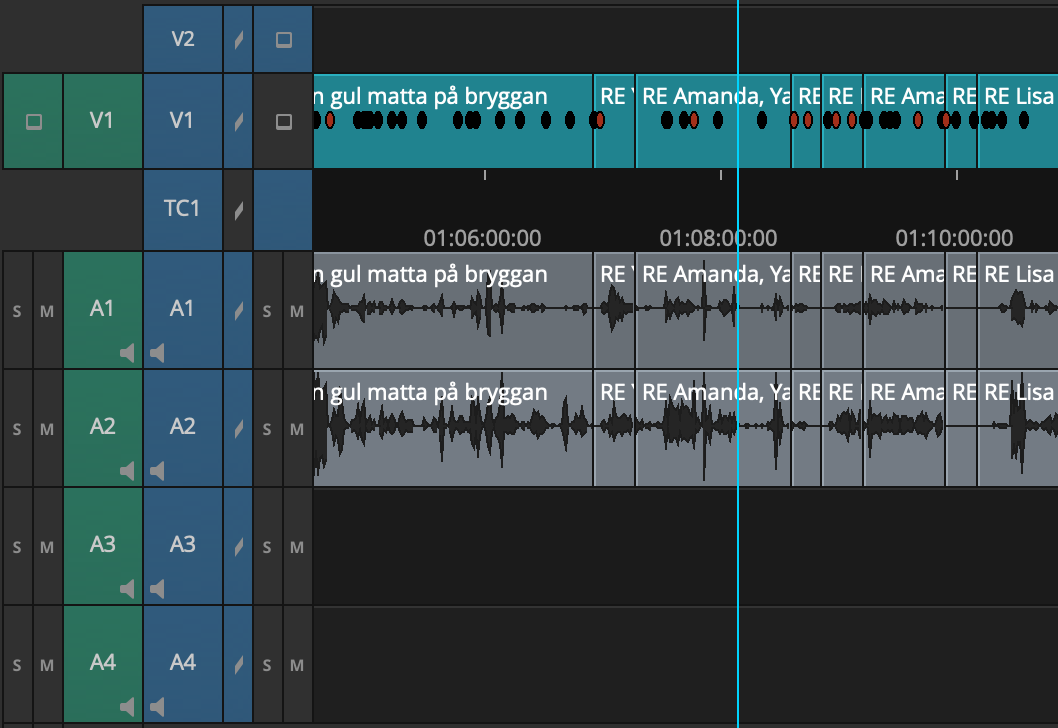
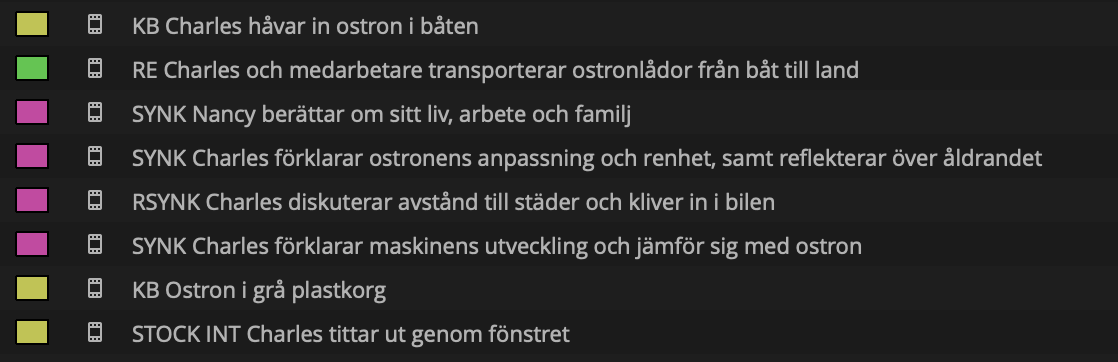
Unscripter watches and listens to your documentary and reality footage, writes a timecoded log of who is on screen, what happens and what is said, and answers editorial questions with an Avid timeline. All of it on a machine inside your building.
Built by a documentary editor, for post houses running Avid Media Composer. Swedish-first, on-prem only.
Unscripter gets you to a logged, searchable record of the material and an ordered string-out of selects. Pacing, rhythm and the emotional cut points stay with the editor.
Every clip gets a timecoded log: who is in frame, shot size, what they do, and a word-timed transcript with the speaker attached. Names come from a cast you enrol once per series, so Amanda is Amanda in every clip.
Ask in plain language and get timecodes back, not a chat answer. Filter on people, on speech versus action, on shot size. Every hit is a real source timecode you can trust.
Paste an editorial brief or a beat sheet. Unscripter finds the best moment for each beat, keeps people and shots varied, never reuses a moment twice, and lays it out in script order as a timeline.
Unscripter is a networked service in your post house. The Avid workstation runs only Avid and a browser.
One photo and a short voice sample per cast member. Add a one-paragraph brief describing the show format. That is all the setup a series needs.
once per seriesExport a bin as AAF and drop it in the web UI together with a short note about the segment. Unscripter finds the media on the shared storage itself.
AAF + briefTranscription, speaker identification, face and body tracking run first. Then a vision-language model describes the footage in content-aligned segments, batch, overnight if needed.
on your GPUDownload a logged bin with descriptive clip names, locators and transcript markers. It relinks to the original media. From here on, editors ask questions and get timelines.
AAF back into AvidUnscripter is built for the way documentary post actually runs: shared storage, bins, locators, and an assistant editor who needs the log in the bin, not in a PDF.
Large production houses sign NDAs that make cloud AI a non-starter. Unscripter treats that as the product, not a compromise: one server on your network runs everything.
A single workstation-class machine with a large-memory GPU serves the vision model and the language model. Sized for a post house, not a data centre.
Open-weight models, served locally. No API keys, no per-minute cloud fees, no footage or transcripts on someone else's servers.
Processing is chunked into fixed time windows, so a 60-minute clip costs no more memory than a 6-minute one. If a job dies at minute 58, you lose one window, not the clip.
Most tools treat Swedish as a translation afterthought. Unscripter runs a Swedish-tuned speech model, writes the log in Swedish and recognises Swedish names and places.
Vision-language models are good at describing and bad at knowing exactly when. So time is anchored by deterministic tools: source timecode, word timestamps, scene cuts, silence. The model only describes pre-cut segments.
A person is named only when a face or a voice matches the enrolled cast. Otherwise they are "Unknown", never a guess. The wrong person is never the one laughing.
Descriptions state what is visible and heard. No invented roles, no "seems to", no dialogue dumps. When unsure, the log describes the appearance, not the interpretation.
Every change is scored against hand-written gold logs and production loggers' own notes on real reality and documentary footage before it ships.
We are onboarding a small number of documentary and reality post houses ahead of launch. Bring a bin, we will bring the log.
Contact us for a demohello@unscripter.ai · Stockholm, Sweden